

 Previous

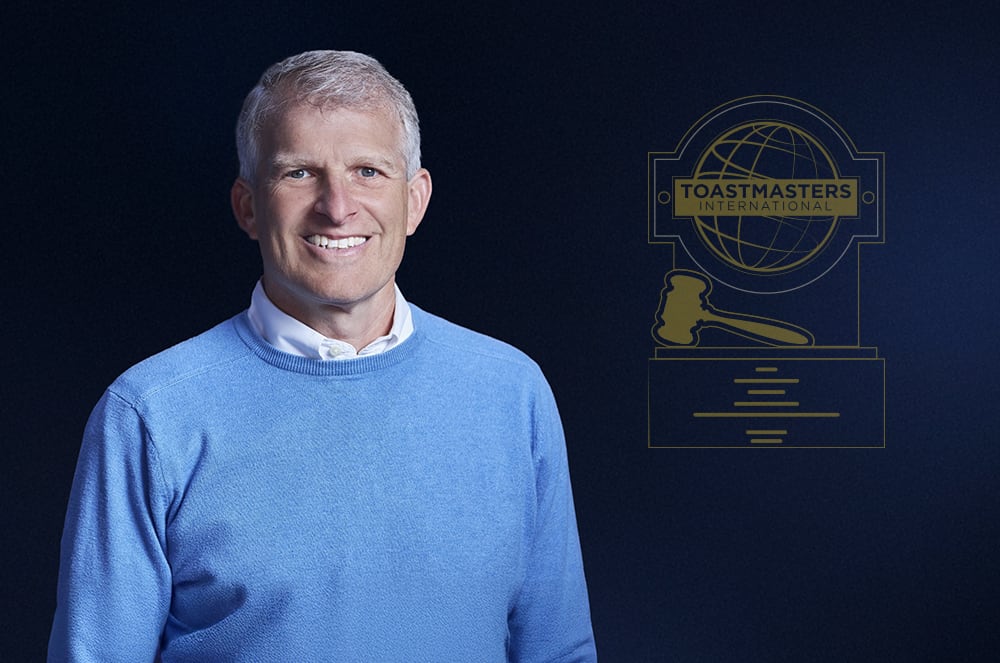
Matt Abrahams, 91´«ý’ 2025 Golden Gavel honoree, has spent his career teaching people to Think Fast, Talk Smart. That grabby, slightly ungrammatical title* graces one of his videos (which has more than 48 million views), as well as his , which reaches listeners in 98 countries. An iteration of the phrase serves as the title of his book, Think Faster, Talk Smarter.
Think Fast, Talk Smart: The Podcast launched in 2020, via the Stanford University Graduate School of Business (SGSB), where Abrahams lectures on strategic communications. The podcast is titled after a talk he gave in 2014 to Stanford alumni—the one that became the YouTube blockbuster. Today, after 219 episodes, the podcast continues to emphasize spontaneous speaking, along with new content that covers a broad range of communication topics. The podcast team digs for unique traditional and emerging subjects for Abrahams and his impressively eloquent guests to dissect.
The program is designed to give listeners two or three “practical, tactical communication tips to practice right away,” says Abrahams. Another staple: At the end of each episode, he asks guests whom they admire as communicators, and to give three ingredients in their recipe for successful communication. The answers spark fresh ideas, actionable research, dynamic discussion, encouragement, counterintuitive advice, laughs, and surprises.
Abrahams delivered his Golden Gavel speech in August at the 91´«ý 2025 International Convention in Philadelphia, Pennsylvania. The annual 91´«ý honor goes to someone who has made a prominent impact in the fields of communication and leadership.
Abrahams, who shared his own communication recipe and top practical insights in a recent interview, clearly loves talking about communication-related issues. That enthusiasm shines through in the podcast.

Key Podcast Themes
The speaking themes that come up most often on the program will be familiar to 91´«ý. “Across all our episodes, three things have come in loud and clear,” says Abrahams. “First and foremost—your audience is paramount. Many of us think success is just broadcasting out an idea; that’s not success. Success is when your audience receives, understands, and appreciates your message, although they don’t have to agree, or be influenced by it.”
The second critical theme is focused listening. “I borrowed this advice from my colleague Collins Dobbs: Give yourself a slower pace, mental space, and the grace to hear and connect with the other person(s).”
Abraham’s third point: Whether negotiating, persuading, or having an everyday conversation, “Communication is a creative act. It’s always done in collaboration with others.” As the saying goes, “It’s never all about you.”
The Swiss Army Knife Tool
There’s more to know about listening, Abrahams says. “Many of us listen for the top line, to get the gist of what’s being said. Then we begin to rehearse, judge, and evaluate. I recommend people listen for the bottom line, because it requires a deeper level of attention.
“I always listen to paraphrase, whether I actually do it or not,” Abrahams adds. In fact, he calls paraphrasing the “Swiss Army Knife of Speaking” because it’s the best, most basic tool to get people on the same page in understanding the message.
Non-verbal clues are also important.
“A colleague once asked me for feedback on a meeting and I started in on negatives, because it hadn’t gone very well,” Abrahams says. “What he wanted in that moment wasn’t feedback but support. Had I noticed how he [exited through] a back door, spoke slowly, and didn’t make eye contact [with me], I would have caught on that his words weren’t congruent with the need.”
3 Surprising Tips
Among his many fascinating podcast guests, Abrahams credits three fellow educators for giving him deeper, even surprising, insight into successful communication.
First is Michele Gelfand, Ph.D., an SGSB colleague who is known globally for her negotiation expertise, especially where culture is concerned. “Michelle helped me realize how important the mindset we bring to communication is,” Abrahams says. “She likes to say, ‘Mind your metaphors.’”
For example, taking the metaphor of a battle into a negotiation influences the entire exchange. With that attitude, “I’m not going to see [negotiation] as a problem to be solved or even a dance, where we take turns sharing,” Abrahams notes.
“We need to be conscious of how we approach conversation—because that influences, even in subtle ways, the words we use, how long we speak, how well we listen.” Abrahams found Gelfand’s perspective a potent reminder that mindset always matters.
A second colleague, Valerie Fridland, Ph.D., a neurolinguist at the University of Nevada, Reno, surprised him with her judicious support for filler words like “ah” and “um.” One of her points that Abrahams found particularly interesting was the way filler words are often used by adults when explaining a new or complex idea to very young children.
“As kids we learn that whatever follows that ‘ah’ or ‘um’ will be relevant or interesting or important. That’s why we’re so attuned to them,” Abrahams notes. However, as adults we get frustrated hearing one filler word after another, without receiving the key details we’ve come to expect.
Fridland, he adds, makes a good case for how a thoughtfully placed “ah” or “um” can subtly yet unmistakenly signal there’s more to say or hear from the conversation.
“Success is when your audience receives, understands, and appreciates your message, although they don’t have to agree, or be influenced by it.”
—Matt AbrahamsAbrahams is also intrigued by conversational turn-taking, a topic studied by his colleague Alison Wood Brooks, who teaches at the Harvard Business School.
“She taught me there are two kinds of turns, supporting and switching,” he says of this third speaking surprise. Supporting conversations involve one topic. The first speaker might say, “I just read the best book ever,” while the responding speaker might ask, “What’s the title? What’s it about?”
A switching conversation changes the topic. The response to the book comment might be, “I prefer tennis to reading.”
Each style is likely to make a significant difference in the experience for both speakers.
“If all I do is support you, it feels like I’m dodging and don’t want to be part of the conversation,” Abrahams notes. “If I keep switching it feels like I’m self-serving and ignoring your needs.”
Research like Brooks’ favors a mix of styles, with slightly more supportive turns, so that people feel good about the conversation and create connections, Abrahams says.

Closing Thoughts
In keeping with the Think Fast, Talk Smart podcast’s traditional ending format, Abrahams lists these top ingredients for his communication recipe, noting he sneaked in more than three.
- Understand your audience; craft a clear speaking goal for them.
- Use a speech structure, such as problem/solution/benefits, or “what, so what, now what,” so listeners can easily follow your points.
- Develop a speaking presence that’s engaging, authentic, and clear.
- Find the feedback you need to see if, and how, your message landed with the audience.
As for admired speakers, Abrahams lists former first lady of the United States Michelle Obama as a favorite, regardless of politics.
“She’s warm, articulate, confident, competent, and has great presence. When you think about effective public speaking, I think she does many things right.
“And, as a person fascinated by spontaneous speaking, I feel like the late comedian Robin Williams had a black-belt ability to speak in the moment every time you saw him. It was a gift, and I would have loved to learn what was going on in his head when he spoke.”
* Oh, and what about that grammar error noted earlier in this story?
Abrahams knows his advice to “think fast, talk smart” isn’t quite grammatically correct. Technically, it should be “think fast, talk smartly.” However, he likes the tiny linguistic twist as a way to draw a little extra attention to what he’s saying.

Share this article
Stephanie Darling is a former senior editor of and frequent contributor to the Toastmaster magazine.
 Previous Article
Related Articles
91´«ý News
Matt Abrahams, 2025 Golden Gavel Recipient

Communication
Improve Your Impromptu Speaking

Presentation Skills