 Previous
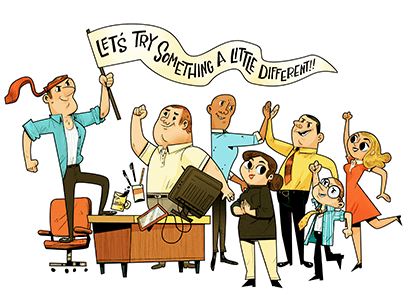
 Illustration by Bart Browne
I鈥檝e always been intrigued by the word 鈥渢hing.鈥� It鈥檚 a word that can have both no meaning and many meanings. It can make you sound profound (Ah, 鈥檛is a thing devoutly to be wished!) or spectacularly ignorant (What鈥檚 that thing you mow the lawn with?). It gives you a word to say when you don鈥檛 know the word to say, or when you simply would rather not say it (You have a thing in your nose). When your teenager backs over your neighbor鈥檚 mailbox, destroys her prized petunia bed, and takes down the clothesline, you can simply say to your spouse, 鈥淲hat about this car thing?鈥� and save yourself the pain of itemizing the breathtaking automotive ineptitude of your offspring.
I am also fond of Thing鈥檚 siblings鈥擲omething, Anything, Everything, and Nothing鈥攚hich multiply your options exponentially, especially when they鈥檙e combined. You鈥檝e heard your physician say, 鈥淲ell, it could be Something or it could be Nothing.鈥� The only thing we know for certain here is that you have an 鈥渋t.鈥� Something means it鈥檚 not Nothing, and Nothing means it鈥檚 not Something. If it鈥檚 Something, your doctor will do Everything he or she can to treat it; if it鈥檚 Nothing, then it really could have been Anything. So you end up with a Something that was a Nothing, meaning your provider doesn鈥檛 have to do Anything because Everything鈥檚 all right. That will be 40, please.
What I am not fond of are Thing鈥檚 cousins: Thingamabob, Thingamajig, Thingummy, and the odoriferous Thingy. True, a Thingamabob is in the Thing family鈥攊.e., a Something about which you obviously know Nothing, including its name. And yes, referring to an object as a Thing can show your ignorance. Referring to it as a Thingamabob or a Thingy, however, not only reveals your ignorance; it celebrates it. Use these words and it won鈥檛 be long before you鈥檒l be employing their cousins鈥擠oohickey, Doodad, Whatchamacallit鈥攁nd then all is lost. Sell your house, move up into the hills, take what food you can, and wait for civilization to return.
You can bring your Things, or you can bring your Stuff, but you can鈥檛 bring the Stuff that has your Things.
This dystopian scenario reminds me of a horror movie from 1982 called (not uncoincidentally, as you shall see) The Thing, a story about an American research team in Antarctica which encounters a parasitic extraterrestrial life form that assimilates and then imitates other organisms, including humans. Paranoia ensues as the scientists all wonder which one of them has become The Thing. Eventually they turn on each other and nobody survives, which probably would have happened anyway just from being stuck in a hut in Antarctica.
The Thing was reviewed as 鈥渋nstant junk鈥� and called the most hated film of all time by Cinefantastique magazine. Quite a distinction. I haven鈥檛 seen it but it can鈥檛 be as bad as some of my home movies. The pertinent point is that this extraterrestrial parasite, in its ability to become whatever it inhabits, is the perfect avatar for our word Thing, for it, too, can become whatever it combines with鈥攁 sweet Thing, a bitter Thing, a foolish Thing, a last Thing, a crucial Thing, a crazy Thing, a great Thing, an awful Thing, a strange Thing, a funny Thing, an only Thing 鈥� ad infinitum.
You can see, then, why I have a thing for Thing. It鈥檚 the writer鈥檚 best friend, ready to jump in at a moment鈥檚 notice when you have neither the time, nor the patience, nor the knowledge to be specific. I鈥檓 sorry I don鈥檛 have time to write about Thing鈥檚 identical twin鈥擲tuff鈥攚hich, like all identical twins, hates being confused with the other. You can bring your Things, or you can bring your Stuff, but you can鈥檛 bring the Stuff that has your Things. The words would collide on the page, causing a minor explosion. And that would be (a) a terrible Thing, or (b) Stuff you don鈥檛 want to deal with.

Share this article
John Cadley is a former advertising copywriter, freelance writer, and musician living in Fayetteville, New York. Learn more at .
 Previous Article