
 Previous
91传媒
This month we look at a couple of pesky questions that often find their way into every speech.
How much of my speech should I memorize?
I have been a Toastmaster for 19 years and a member of 13 different clubs. One characteristic of every club, besides too many 鈥渦m鈥檚鈥� and 鈥渁h鈥檚,鈥� is that members hate memorizing their speeches. Is that a problem?
The answer is 鈥渢hat depends.鈥�
If you are competing in a speech contest, you have to memorize it. But if you are scared stiff in a club meeting, don鈥檛 worry about memorization.
Additionally, if you are working on your speechwriting skills, focus on that instead of memorizing. Ideally, however, memorization can help your delivery.
What benefits does memorization provide?
First, it frees you up to focus on how you deliver your speech. If you don鈥檛 have it memorized, a part of your mind will be thinking about what words should come next. And that will yield a flat delivery. Your audience responds to the emotions you convey in your speech. If you have little emotion, their response will be subdued.
Second, memorization enables you to deal with the inevitable interruptions. See the second question for tips on how to handle this.
Now let鈥檚 look at long-form speeches鈥攕ay, 20 to 60 minutes. That鈥檚 too long to memorize a speech.
When speaking about a topic I understand, I know each segment pretty well, so I can mostly speak off the cuff. I do have a note sheet, but it only has the main points on it.
If I鈥檓 speaking about a new topic, or there are a number of quotations, I use detailed notes. I do have to be conscious of how well I am connecting with the audience, though. Reading and looking at the audience is not an easy skill.
So, how much should you memorize? Use your best judgment, but keep in mind that the needs of the audience are far more important than your own.
How do you handle interruptions?
Interruptions during your speeches are about as unavoidable as death and taxes. Expect them.
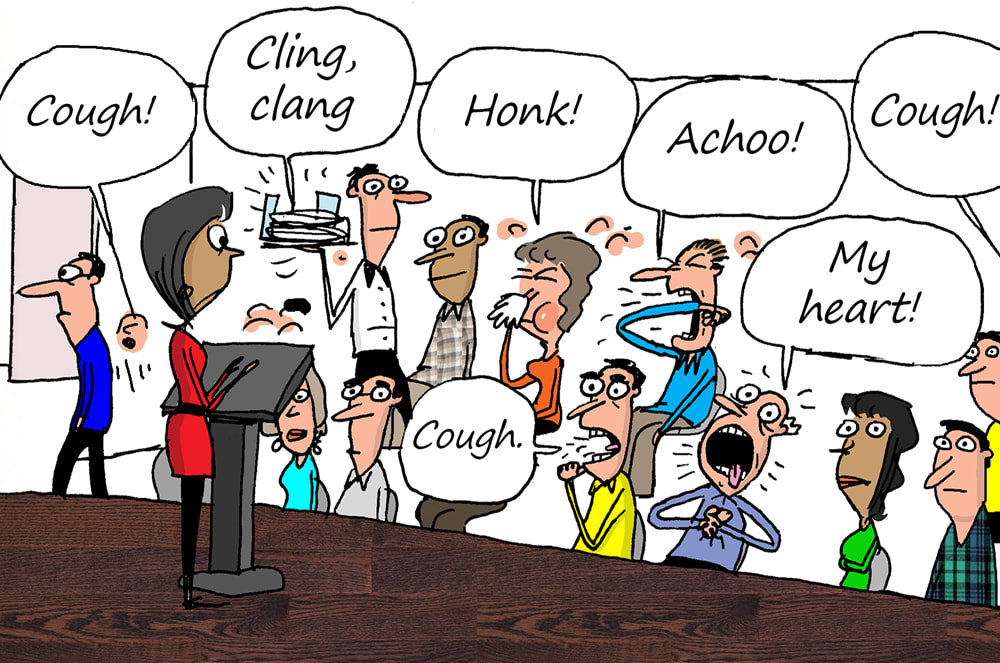
Many interruptions are minor, such as a cough or sneeze. It is best to ignore most of these. If someone is a constant disruption, you might need to address it, but if you can keep going, do so.
If you are competing in a speech contest, you have no choice but to keep going. One time I was competing at the District level in the International Speech Contest. It was a dinner meeting, and the meal was running late, but they decided to continue with the contest anyway. During the first few minutes of my speech, the servers were handing out dessert. Clanging dishes are not fun. Then in the middle of the speech, a woman decided to blow her nose鈥攍oudly! Fortunately, I knew the speech well enough that those distractions did not faze me.
But what if there is a major event like a medical emergency?
I was in a meeting once where paramedics came into the room. The health issue wasn鈥檛 critical, so the speaker told the medical team to do what they had to do. And he continued speaking.
On the other hand, I was in a different meeting when an attendee went into cardiac arrest and needed CPR. Chairs were thrown to the side to make room for the procedure. Needless to say, the speech took an intermission.
When you are the speaker, you must decide what to do when something unforeseen happens. Most interruptions are minor. In those instances, it helps if you have most of your speech memorized. That way you can keep going without skipping a beat.

Share this article
Bill Brown, DTM is a speech delivery coach in Gillette, Wyoming. He is a member of Energy Capital 91传媒 in Gillette. Learn more at .
 Previous Article
Related Articles

Presentation Skills
Techniques To Remember Your Speech

Presentation Skills